Tired of London, Tired of Life - A website about things to do in London

***

***

For more regular updates, visit Tom's Britain, a new website about things to do in Britain.


***

30 March 2011

Find the Cádiz Memorial

In the South Eastern Corner of Horseguards Parade, the Cádiz Memorial commemorates the success of forces led by Wellington in defeating French forces near the Spanish city of Salamanca, and lifting the siege of Cádiz in 1812.


Consisting of a large French mortar 'cast for the destruction of that great port, and abandoned by the beseigers on their retreat', mounted on the back of a winged iron dragon. It was given by the Spanish to the Prince Regent, and mounted on a base constructed at the Royal Arsenal in Woolwich in 1814.

For more on the memorials of Horse Guards, see http://www.secret-london.co.uk/Horseguards.html

29 March 2011

Walk among the ruins of Lesnes Abbey

Your author has been accused of becoming rather South-East-London-centric of late, but he has just moved house, so he hopes readers will humour him. Normal service will be resumed shortly, but until then let's examine another gem in an the area, for in parkland below Abbey Wood lie the ruins of Lesnes Abbey.


Founded by Richard de Luci in 1178, and visited by Edward I, Lesnes Abbey was noted for its involvement in the Peasants' Revolt, when the abbot was forced to swear an oath of support to the rebels, and also for the Abbot's involvement in draining nearby marshland.

By the 1520s, however, the Abbey was dissolved as part of Henry VIII's wider plans, and later fell into disrepair. It was only in the 20th Century that it came to be of local importance once again, with Woolwich & District Antiquarian Society excavating, and the land ownership passing to London County Council around 1930.

Today, it is part of a larger park with the wood behind offering an idea of how the site might have looked to the monks. For more, see http://www.bexley.gov.uk/index.aspx?articleid=3907

28 March 2011

See inside Watt's Workshop

In tribute to the great man whose works helped to kick-start the Industrial Revolution, the Science Museum has recreated James Watt's legendary attic workshop in a new exhibition on the ground floor.


It's an excellent opportunity to metaphorically get inside the mind of Watt and see what made him tick, from the meals he had left outside his workshop heating on the stove, to the 8,430 objects he kept there, which helped to inform him about the way the world worked.

The workshop was left after Watt died in 1819, and locked with its contents untouched. It remained largely this way until 1924, when the decision was made to pack up the complete workshop and its contents and take them to the Science Museum for safekeeping.

The exhibition is free, and is very interesting. It's just a shame that the curved glass - which allows visitors to walk inside the workshop - is so reflective and makes it quite hard to look closely at the many fascinating objects.

For more information, see http://www.sciencemuseum.org.uk/visitmuseum/galleries/watts_workshop.aspx

^Picture provided by the Science Museum^

27 March 2011

Take a foreshore walk with the Thames Explorer Trust

Your author has always been a fan of wanders on the Thames Foreshore, when the tide is right, and even took his parents down for a look yesterday, but often it can be frustrating looking at things you know are probably significant, but having no guide to tell you what's what.


The good news is that someone has already thought of this, and this afternoon the Thames Explorer Trust take walkers on one of their regular foreshore walks, beginning from the North end of the Millennium Bridge at around 2.30pm.

It's a good idea to book, and take wellies or walking boots, and tickets cost £8, but with the promise of a walk in the footsteps of the Victorian street children, who scraped a living ‘mudlarking’, it sounds worth the money.

There are also other regular walks in different parts of London. For more information, see http://www.thames-explorer.org.uk/adult/foreshore-walks

26 March 2011

Watch the Boat Race

There's only one big ticket event in London this afternoon, with the 157th Boat Race between Oxford and Cambridge Universities kicking off at 5pm. They'll be rowing roughly four miles 374 yards, for no particular reason other than they quite like both winning stuff, and their university.


The series has taken place since 12th March 1829, when Cambridge sent a challenge out to the Oxford boys to see who was best at rowing. It's been going more-or-less ever since, and Cambridge go into the 157th event with a series lead of 80 races to 75, so it's still pretty close. No one is quite sure where if and when it will end.

Those who join the 250,000 spectators along the banks of the Thames between Putney and Mortlake should expect to hear plenty of plummy voices and braying laughter, for this is not a working class event. Nevertheless, it's reasonably fun, and with exam season coming up these Oxbridge types won't be allowed to leave the library much at the moment, so you have to let them have their fun when they can.

For more, see http://www.theboatrace.org

^Picture © Magnus D used under Creative Commons^

25 March 2011

Admire Westminster Cathedral

When most people think of a Cathedral in Westminster, they go straight for Westminster Abbey, but there's another one. This one is for those nice Catholics, and it's free to have a look inside.


Built on a site acquired by the Catholic Church in 1884, it was designed to reflect the Byzantine style of early Christianity by Victorian architect John Francis Bentley. The first stone was laid in 1895, and work completed eight years later. It was formally consecrated in 1910 and as such celebrated a centenary last year.

Much of the art inside was added later, and as Bentley died before the Cathedral was opened it was up to future artists and architects to ensure these fitted with the rest of the Cathedral.

The Cathedral is the largest Roman Catholic church in England and the seat of the Catholic Archbishop of Westminster, Archbishop Vincent Nichols.

For more information, see http://www.westminstercathedral.org.uk/

^Picture © Catholic Westminster used under Creative Commons^

24 March 2011

Take in the view from One Tree Hill

One Tree Hill, in South London, is a park which as the name suggests, is atop a pretty little hill, overlooking Peckham and South London, which has led a varied life, and was famously once a picnic spot for Elizabeth I.


The hill stands five miles south of London Bridge, largely wooded in an area which would have once formed part of the famous Great North Wood, and offering views out from strategically placed holes in the canopy towards Central London.

The hill is, apparently famous for attracting artists to paint its scenes, but its strategic position also attracted the Honorable East India Company, who used it as one of a chain of semaphore stations during the Napoleonic Wars, in order to signal vessels in the English Channel from Central London. It was also used as a gun emplacement During the First World War.

For more on the hill, visit http://www.onetreehill.org.uk/

23 March 2011

Visit the Wandle Industrial Museum

Based in a small hut beside Vestry Hall, on the Cricket Green in Mitcham, South London, the Wandle Industrial Museum is a small museum examining industry along the River Wandle which was, we are told, once the most industrialised river in Europe.


It sounds like a worthy little museum, examining the history of the mills along the Wandle - from trout fishing to firework production - and offering occasional displays of block printing. It is soon to move to larger premises at Ravensbury Mill on Morden Road, which should offer plenty of room for expansion.

When your author popped by at the weekend it was sadly closed, for its eccentric opening hours mean visitors are only welcome on Wednesdays from 1 - 4pm and on the first Sunday of the month from 2 - 5pm. Entrance is 50p, or for children & senior citizens, who presumably cannot afford such high living, a reduced price of 20p is offered.

For more information, see http://wandle.org/

22 March 2011

Eat at Fatboys Diner

At Trinity Buoy Wharf, deep in the Docklands, is Fatboy's Diner, London's own American diner, seemingly built in 1941 in New Jersey, USA, and imported to the UK at some point, possibly via Liverpool Street.


It's website boasts that it is 'ideally located against the backdrop of London's only Lighthouse, and the Millennium Dome accross the Thames' and your author thinks that is stretching it a bit. Ideally located for the handful of people who work at Trinity Buoy Wharf perhaps, but realistically about half an hour on the DLR for most people, then a ten minute walk.

Nevertheless, it's a beautiful spot when you get here, specialising in burgers, breakfasts and milkshakes. For more information, visit the website at http://www.fatboysdinerlondon.com/

21 March 2011

See a play at the Noël Coward Theatre

Previously known as the New Theatre and the Albery Theatre, and originally opened in March 1903, the Noël Coward Theatre, on St Martin's Lane, is a Grade II Listed building, with seats for 872.


Designed by architect William Sprague, who is responsible for a number of other theatres including the Aldwych and the Gielgud, the interior was, we are told, designed in the Louis XVI style with use of white and gold.

Now owned by Delfont Mackintosh, who undertook refurbishments in 2005, the theatre features three licensed bars - the Stalls Bar, Lionel's Bar and the Oliver Bar. For more information, see http://www.delfontmackintosh.co.uk/Theatres/noel_coward.php

20 March 2011

Walk in South Norwood Country Park

It was once part of the Great North Wood and since then it has been a sewage farm, farmland, allotments, and a refuse dump, but now the South Norwood Country Park is a fantastic 125 acre park for the use of the local community, and those like your author who are happy to travel to the latter pages of the A to Z to visit it.


Complete with a wild flower meadow, a wetland reserve and lake, a childrens playground and even an interesting visitors centre, the park is now designated a Local Nature Reserve and attracts over 100 different species of bird each year.

From the top of the viewing mound at the Southern End of the park, you can enjoy views to the Docklands sky scrapers, the Crystal Palace Transmitter, and across South London. Trams drift quietly by, and the high-rise buildings of central Croydon, so beloved by Nicholas Sarkozy, also loom large, shimmering in the distance on a clear day.

When your author was there yesterday, some optimistic souls were trying to fly a kite, which was a little hopeful, but it would be a lovely spot for kite flying if there were any wind.

For more on South Norwood Country Park, click here.

19 March 2011

Welcome HMS Bulwark

As highlighted by Ianvisits, who is always fantastic at spotting these things, the HMS Bulwark, a 176 metre, 21,500 tonne Albion-class landing platform dock amphibious assault warship, is in Greenwich this week.


The ship is one of our largest and most technologically advanced amphibious assault and command and control ships - whatever that means - and is here to show us all how brilliant it is, and to host important visitors. Sadly however, readers, we are not important enough, and will have to gaze upon it from the banks of the Thames.

Still, it's nice to see these things, and hopefully the crew will get a bit of shore leave whilst they're here. For more information, visit the Royal Navy Website.

^Picture © mashleymorgan used under Creative Commons^

18 March 2011

Drink at the Duke of Sussex, Waterloo

Notable for its distinctive Truman, Hanbury, Buxton & Co exterior, the Duke of Sussex, in Waterloo, is a nice pub which attracts a range of after-workers and locals with its relaxed and friendly atmosphere.


When your author visited last night, as he often does on a Thursday, there was a choice of tables, and the pool table was free, despite this being a thoroughly Central London pub, a stones throw from a huge railway station, on St Patrick's Day. That is its beauty.

Amongst some staff from Christian Aid, across the road, the pub is known affectionately as "the old man's", because it lacks the try-hard atmosphere of other local pubs. For here, rather than cocktails and loud music, there are ales, walls adorned with pictures of the neighbourhood in days gone by, and postcard scenes of long-dead locals on coach trips to the seaside. Your author likes it that way.

Whilst it was nothing gastronomic, and its readiness is announced with a 'ping', there was also cheap food available from Tracey's Kitchen, in the back bar. For more on the Duke of Sussex, see http://www.fancyapint.com/pubs/pub1231.php

^Picture © Kake Pugh used under Creative Commons^

17 March 2011

Book a ticket to the Troxy

Situated on Commercial Road, in the heart of East London, the Troxy is a former cinema which is now a fantastic venue for a diverse range of events, and some fantastic gigs. It attracts some brilliant bands, and has witnessed some great shows, and if that's not your sort of thing, Gary Numan's on in a couple of weeks.
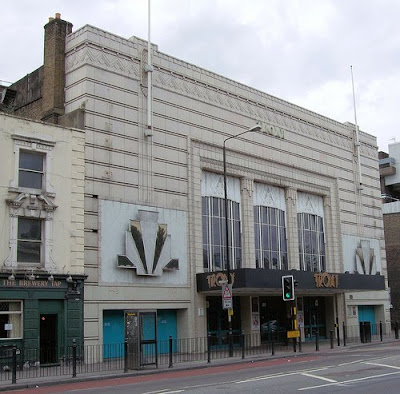

Between 1933, when the first film shown was "King Kong", and 1960, when it closed with "The Siege of Sidney Street", the cinema had a capacity of over 3,000 people. It subsequently became a venue for Royal Opera House rehearsals, and then a Mecca Bingo, closing in 2005.

Since being acquired by its current agents, it has been converted into, in your author's opinion, one of the better venues in London to watch live music, with restoration of some of the original bits adding a great atmosphere, and sound quality holding up well.

When your author last visited, it was to see a left-wing singer-songwriter who kept banging on about the unions - in between trying to flog teatowels - but when he was singing it was very pleasant. That said, it's not all pop music, and tonight sees - bizarrely - a boxing match between Oxford and Cambridge, so it's probably best to just keep an eye on the what's on section, and see if anything pops up you fancy seeing.

For more on all things Troxy, visit http://www.troxy.co.uk/

^Picture © Jim Linwood used under Creative Commons^

16 March 2011

Visit the Savoy Chapel

Also known as the Queen's Chapel of the Savoy, the Savoy Chapel is situated behind the Savoy Hotel and is the only remaining piece of Henry VII's hospital for homeless people, founded in 1512.


Owned by the Queen through the Duchy of Lancaster, one of the vast land estates still personal possessions of members of the monarchy, the chapel is a free church and does not fall within the jurisdiction of any bishop.

The church gets its name from an original which was part of John of Gaunt's medieval Savoy Palace, on the same site, and was burned down in the Peasants Revolt of 1381. For more information, see the Duchy website.